Saturday, March 29, 2014

Justifying Area

Our recent emphasis in the Math Workshop has been with estimating and justifying the area of irregular shapes.

One tool that we have used to justify the area formulas for rectangles and right triangles has been the Geoboard.

Formula for Rectangles (Area = Base x Height) Formula for Triangles (Area = 1/2 Base x Height)


Consider the irregular polygon shown on this Geoboard template.

What is the area of this pentagon?

During Math Workshop, we have approached the task of finding solutions to problems similar to this by decomposing the figure into smaller rectangles and right triangles so that we can use the area formulas for the smaller parts and then put those smaller totals together to find a justified total area.


The green rectangular area in this pentagon has a base of 3 units and a height of 2 units, so the area of this rectangle is 6 square units.

   Area of a Rectangle = Base x Height, so 6 = 3 x 2.

   (We also reference the area formula as length x width.


The right scalene triangle (brown) shown on the grid is exactly HALF of 2 square units (the dotted lines are shown to illustrate this idea). Therefore, the area of the triangle is 1 square unit.

Area of a Triangle = 1/2 Base x Height

The base of the triangle is 1 unit and the height of the triangle is 2 units.
(1 x 2) ÷ 2 = 1
A right scalene triangle is exactly half of a rectangle.

 
The right isosceles triangle (blue) shown on the grid is exactly HALF of 1 square unit (the dotted lines are shown to illustrate this idea). Therefore, the area of this triangle is 1/2 square unit.

Again, Area of a Triangle = 1/2 Base x Height

The base of this triangle is 1 unit and the height of the triangle is 1 unit. (1 x 1) ÷ 2 = 1/2

A right isosceles triangle is exactly half of a square.


All decomposed parts are then combined to identify the total area of the figure.


The area of the pentagon is 7 1/2 square units!!

Students, you can have fun with virtual Geoboards by clicking the link below, which will take you to the Virtual Library of Math Manipulatives. (A parent may have to install Java in order for you to utilize this site.)

Click Here: VIRTUAL GEOBOARD FUN


Also, if you would like to practice with transformations, you can click the links below for some more virtual fun!

Virtual TRANSLATIONS (Slides)


Virtual REFLECTIONS (Flips)


Virtual ROTATIONS (Turns)


If you utilize these online resources, leave a comment to let your teachers know so you can earn some extra Behavior Bucks!

Tuesday, March 25, 2014

Erosion and Deposition

This slideshow is very helpful in emphasizing many of the main points we have been talking about in Science this week. Enjoy!

Saturday, March 1, 2014

The Amazing Rock Cycle

Huge boulders, tiny grains of sand, silt, clay ~ all are made of rocks. Even though rocks are non-living, they can change in form both above and below the Earth's surface. In Science, we have been learning about how scientists classify rocks according to the way in which they were formed and we know that there are three main "kinds" of rocks: igneous, sedimentary, and metamorphic.
 
After using hand lenses to closely observe various properties of rocks (perusing through our classroom's three rock collections), we then turned our attention to two awesome virtual labs (Gizmos): Classifying Rocks and The Rock Cycle. We also researched our textbook for important information and also had fun with a Snickers candy bar correlation- be sure to discuss this at home! :-)
 
Here are some highlights of what we have learned:
 
  • Igneous rocks form from other rocks that have MELTED. Melted rock below the Earth's surface is "magma" and melted rock that reaches the Earth's surface is called "lava".
  • Mineral crystals form when lava cools IF they have time to form. Quickly cooling lava may have NO crystals- the longer it takes for molten rock to cool, the larger the crystals may form.
  •  
  •  
  • Sedimentary rocks form when layers of sediments settle on top of one another and harden. Sediments are made up of soil, shells, bits of rock, and dead plant and animal matter It is in these rocks that FOSSILS are found!  (Be sure to discuss our bread and gummy bear layering demonstration at home.) :-)
  • Water, wind, ice, and gravity move the sediments that form these rocks. Over time, these particles settle in layers and press older layers together, which hardens them and forms rocks.
  • Metamorphic rocks form from high temperatures DEEP inside the Earth. These rocks are also under a lot of pressure from the weight of the rocks that are above them. These "forces" can cause rocks to change their form into metamorphic rocks. The heat and pressure can even cause the mineral crystals in the rock to change! Chemicals in some rocks also cause other minerals to form. (Most rocks are made up of different combinations of minerals.)
  • It is amazing that metamorphic rocks can form from sedimentary, igneous, AND other metamorphic rocks! Look at the diagram of the rock cycle at the beginning of this post to see just how interconnected the three types of rocks are.
  • Students, what has been your favorite experience in class in learning about the Rock Cycle? Leave a comment to earn Behavior Bucks!
  • Happy Science Sleuthing,


Sunday, February 9, 2014

Penny Jars and Cube Towers

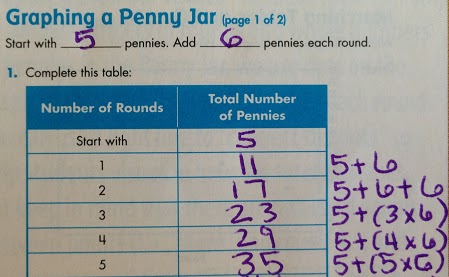
Our Math Workshop emphasis in recent weeks has been centered around analyzing relationships between two quantities in situations of constant change. These situations have started out very concretely, through using actual pennies and linking cubes, and then representing these situations more abstractly with arithmetic expressions.
In the above "penny jar" situation, there is a starting number of 5 pennies in the "jar". Then, 6 pennies are added each "round". The total number of pennies shown is (5 x 6) + 5, or 35 pennies. Students have been challenged to extend patterns such as this one, in order to determine the total number of pennies for any round. If asked to identify the number of pennies in the 20th round, for example, students would determine that there are 20 groups of 6 pennies (20 x 6), and then 5 more (+5) when including the "starting" pennies in the jar: 20 x 6 + 5 = 125. There would be 125 pennies in the jar after 20 rounds of adding 6 pennies each round. The most general arithmetic expression to represent "any" round might be n x 6 + 5, or 6n + 5.

These Investigations (from our Scott Foresman curriculum tool) have provided tables, such as the example shown above, in helping students make sense of (and represent) these situations algebraically.

In the above "double tower" situation, there are two skylights. As new "floors" are added to the double tower, the number of skylights never changes. Students have learned to represent this as "+2". Each time a floor is added, however, the double tower gains 6 new windows. The example above has 2 floors. This would be represented as 6 + 6 + 2, or 2 x 6 + 2. There are a total of 14 windows on this tower. Again, students have learned through active exploration (by actually constructing various towers with linking cube manipulatives as they fill in provided charts) how to represent this situation with a general arithmetic expression: n x 6 + 2 (6n + 2). How many windows would be on the 100th floor of this tower? To solve, students would simply calculate 100 x 6 + 2. A 100 floor double tower would have 602 windows.


Upcoming investigations will include building, analyzing, and representing Corner Towers & Square Towers. Students will be challenged to represent these situations of constant change by creating an arithmetic expression using a variable so that the number of windows on ANY given floor can quickly be determined.


Happy Mathematizing,


Saturday, January 25, 2014

Navigating Historical Fiction: Focusing on Setting First

Readers at Wild Adventures are quickly falling in love with a new genre -- historical fiction!

Often, when students come to fourth grade, they still think books are one of two "genres": fiction or nonfiction.  This year, readers are learning that calling a book "fiction" or "nonfiction" is like saying a dog is an animal or an oak tree is a plant.  There is so much more that we could say!  We can consider "fiction" and "nonfiction" the "kingdoms" of the literary world, and now that we're older, we are getting to know the "species" within each.

Recently, we learned that we read historical fiction much the same way as we would read any other type of narrative text (mystery, realistic fiction, narrative nonfiction, etc.).  We focus deeply on the characters.  However, as we read stories that take place in times (and sometimes places) far away from the world we live in, we also need to pay careful attention to the setting.  Where in the world is this taking place?  When in history is this story set?  Once we've established the where and when in a global sense, we move towards understanding the traits of the setting, just as we would understand the traits of a character.

In our newest read aloud, Esperanza Rising by Pam Muñoz Ryan, the year (1930) and geographic location (Aguascalientes, Mexico) are clearly announced to the reader.  As we read on, we learned Esperanza's family owns and lives on a vineyard and ranch, El Rancho de las Rosas.  But in order to truly understand Esperanza's story, we have to understand what kind of place and time this really was for the people living within it.

"Everyone who lived and worked on El Rancho de las Rosas was gathered at the edge of the field:  Esperanza's family, the house servants in their long white aprons, the vaqueros already sitting on their horses ready to ride out to the cattle, and fifty or sixty campesinos, straw hats in their hands, holding their own knives ready."

This passage revealed to many readers in our room that Esperanza's home was a wealthy home.  It was the kind of place that probably left Esperanza wanting nothing she didn't already have.

Later, as we read descriptions of the fiesta that occurred each year after the harvest, and Esperanza's thoughts about her future Quinceañeras, many readers said they could tell it was a traditional home, consistent and predictable from year to year.  We know that carrying these understandings with us as we walk with the characters through their story is important because it helps us have empathy and a deeper understanding of the characters behaviors, actions, choices, and traits.

Readers, revisit this passage from the first chapter.  Think carefully about the details Pam Muñoz Ryan included.  What words would you use to describe the setting of our story after you've reread this passage closely?

"He swept his hand toward the grapevines, signaling Esperanza.  When she walked toward the arbors and glanced back at her parents, they both smiled and nodded, encouraging her forward.  When she reached the vines, she separated the leaves and carefully grasped a thick stem.  She put the knife to it, and with a quick swipe, the heavy cluster of grapes dropped into her waiting hand.  Esperanza walked back to Papa and handed him the fruit.  Papa kissed it and held it up for all to see.  
'¡La cosecha!' said Papa.  "Harvest!"
'¡Ole! ¡Ole!'  A cheer echoed around them.
The campesinos, the field-workers, spread out over the land and began the task of reaping the fields.  Esperanza stood between Mama and Papa, with her arms linked to theirs, and admired the activity of the workers.
 'Papi, this is my favorite time of year,' she said, watching the brightly colored shirts of the workers slowly moving among the arbors.  Wagons rattled back and forth from the fields to the big barns where the grapes would be stored until they went to the winery."

I can't wait to see your thinking in the comments below!
 

Sunday, January 12, 2014

Multicultural Luncheon

Multicultural Luncheon on PhotoPeach


Plantain chips from Cuba, Empanadas from Mexico & Colombia, Tea & Cookies from England, Scones from Scotland, Petit Fours from France, Swedish Meatballs from Sweden, Eggrolls from Vietnam, Pasta from Italy, Baklava from Greece, Latkaes & Gelt from Israel, Rolled Cabbage from Romania, Enchiladas from Mexico, Apple Dessert from Germany, Brats & Sauerkraut from Germany, Dessert from India, Matzah Ball from Central Europe, Pastry Meringues from France.....We had a delightful time with our family members who were able to attend. What a great opportunity for fellowship and fun! Many students even tried "new" things that they had never tasted before. Thank you to everyone who was able to contribute toward our luncheon's success.

St. Augustine

St. Augustine 2014 on PhotoPeach


Our trip to St. Augustine was a memorable one. The weather was perfect and our tours were very informative. Here are a few FUN FACTS that we learned while there:

1) The Castillo cannons could shoot a cannon ball a distance of about 3 1/2 miles.

2) The Catholic Cross where Pedro Menendez first arrived in St. Augustine is 208 feet tall. If it were any taller, it would need a red light to be visible to airplanes!

 3) The oldest resident of St. Augustine is "Old Senator"- very large oak tree.

4) The Lightner Museum used to be one of Henry Flagler's hotels- there used to be a large indoor pool in there that measured 150 feet by 60 feet. (What was the area of this pool?)

 5) St. Augustine marks the beginning of the Trail of Tears (which we will learn more about later this year).


Students, what other FUN FACTS can you remember? Leave a comment to tell us something interesting that you learned and you will earn $5 behavior bucks!