Hello Readers!!
Can you believe we're already halfway through the summer? How is your reading going? I just checked the Scholastic.com Summer Reading records and was SO PROUD of the minutes I saw logged!
In my house, we've settled in to a comfortable afternoon reading routine. In fact, we've started calling it the "Reading Plus Program". We curl up in a cozy spot and read everyday for at least 30 minutes, log our minutes using the Scholastic Summer Reading app for iPhones, iPads and iPods, and then move on to something else. For instance, on Mondays it's "Monday Math", and we log onto iReady or Reflex some fun math time. Other days, we might choose to write a story or write a letter to a friend or family member. Sometimes, we'll practice cursive writing or play a game that makes us think. (Psst! Did you know that we have reading activities available on iReady this summer?)
If you haven't been reading or logging, it's not too late! I know there are a lot of summertime distractions that make it hard for us to slow down and take care of our reading routines, but it is important to make reading a priority all year long. Make today the day you get back to your books. Not sure what to read? Ask a friend!
Readers, what great books have you enjoyed this summer?
Monday, July 14, 2014
Saturday, May 24, 2014
Celebrating Reading
It is amazing to me to look back to August and remember the readers that entered our classroom. We have come so far! But did you know that when kids don't read over the summer, they are likely to fall behind when they head back to school? These learning losses are often called the "Summer Slide", and our school has made it a priority to keep our students' skills sharp by encouraging them to read all summer long.
Chets Creek has signed up to participate in the Scholastic Summer Reading Challenge, a free online reading program that invites children to log their reading minutes to help set a new world record for summer reading. the goal this year for schools around the world is to break last year's reading world record of 176,438,473 minutes!
I'm SO excited to share that the theme of this year's program is Reading Under the Stars. As kids log their reading minutes, they will unlock star constellations and learn interesting facts about them. Plus, throughout the summer, kids will earn digital rewards and learn about great new books to read. You'll also find free articles, activity sheets, and book lists for parents on the Scholastic Summer Reading Challenge website. Look for your child's username and password in their planner Tuesday evening.
But that's not all! In order to celebrate our reading successes this year, I'd like to invite you all to join me at the P.E.P. Rally next weekend, Saturday, May 31st, at the Jaguars' Cabanas/Fan Entertainment Zone at Everbank Field. Not only will I be there, proudly wearing my purple shirt to support Chets Creek, for the 8 AM "Spirit 5K", but I plan to stay and enjoy the food and fun afterwards. Please join me for the party and celebrate our amazing year! If you're not up for running a 5K, consider participating in the free one mile "Reading Is Fun Run" at 9 AM, or just come for the Reading Celebration from 10 AM-2 PM! Remember to wear your purple!
I hope to see you all there!
Tuesday, May 20, 2014
Garden Adventures
Wow! What a beautifully sunny and breezy day as we spent time working in our amazing Chets Creek garden. One of our very own incredible parents, Dr. Brenda Zenk (Nicole's mom), led us on a very special adventure which helped us to make many connections about how plants and animals interact in their environment (something we are currently studying in Science). We also made many important connections about how various plants reproduce. We got our thumbs greener by observing a wide variety of flowers blooming in our garden, finding many pollinators at work (bees, butterflies, and ants), collecting seeds (lettuce, arugula, mustard, radish, and bok choi), cross-pollinating lettuces, digging for potatoes and beans, smoothing soil, pulling weeds/nutgrass, trellising tomatoes, and planting new watermelon seeds! Enjoy our slideshow to highlight this incredible experience. Thank you, Dr. Zenk, for helping us to make some special Chets Creek memories and for helping to make our science studies really come to LIFE!!! Your plethora of knowledge is truly inspiring to ALL of us!!
Garden Experience on PhotoPeach
Students, what was your favorite part of your garden visit? Leave a comment and earn Behavior Bucks!
Monday, April 14, 2014
Phases of the Moon
In Science we have really been enjoying ourselves learning about the phases of the Moon. During the month of April, students have been observing the Moon each night outside their window and recording it's changing appearance, allowing them to see and experience our Moon's 29 day cycle.
Mr. Lee's Moon Rap video has also been a wonderful reference for us in class- check it out HERE.
We have learned that the Moon has phases because it orbits Earth, which causes the portion we see illuminated to change.
The Moon takes about 27 days to orbit Earth, but the lunar phase cycle (from new Moon to new Moon) lasts about 29 days. The Moon spends the extra 2 days "catching up" because Earth travels about 45 million miles around the Sun during the time the Moon completes one orbit around Earth.
As we continue to study the Moon's phases we will complete a Moon Phase Gizmo, make edible "Oreo" Moon cycle models (yum) and compile little flip-booklets to help us learn what each phase is called. In doing this we will also deepen our understanding of several landmark moon phases. These are:
1) New Moon (the first (1)and last (29) day in the cycle
At the New Moon phase the Moon is so close to the Sun in the sky that none of the side facing Earth is illuminated. In other words, the Moon is between Earth and Sun.
2) First Quarter Moon (around Day 8 in the cycle)
ONE QUARTER (the RIGHT quarter that we see) is lit....here, the moon is highest in the sky at sunset, then sets about six hours later.
3) Full Moon (around Day 15- the middle of the 29 day cycle)
On this day, the Moon is behind Earth in space with respect to the Sun. As the Sun sets, the Moon rises with the side that faces Earth fully exposed to sunlight. We are able to see the entire illuminated half of the moon!
4) Last (Third) Quarter Moon (around Day 21) ONE QUARTER (the LEFT quarter that we see) is lit.... (opposite of the First Quarter Moon).
Other terms students need to be familiar with help to explain other phases that fall between these landmark phases are Waxing, Waning, Crescent and Gibbous.
Waxing means "increasing" in illumination
Waning means "shrinking" in illumination
Crescent means "with concave and convex edges" (where less than half of the moon is illuminated from our perspective... think of a curved pastry or dinner roll)
Gibbous means "humpback" (where more than half of the moon is illuminated from our perspective)
Here are several examples:

You can click HERE to see a simple, quick time-lapsed video of the Moon Phase Cycle that really helps to show how all of these phases relate and change throughout the cycle.
Mr. Lee's Moon Rap video has also been a wonderful reference for us in class- check it out HERE.
We have learned that the Moon has phases because it orbits Earth, which causes the portion we see illuminated to change.
The Moon takes about 27 days to orbit Earth, but the lunar phase cycle (from new Moon to new Moon) lasts about 29 days. The Moon spends the extra 2 days "catching up" because Earth travels about 45 million miles around the Sun during the time the Moon completes one orbit around Earth.
As we continue to study the Moon's phases we will complete a Moon Phase Gizmo, make edible "Oreo" Moon cycle models (yum) and compile little flip-booklets to help us learn what each phase is called. In doing this we will also deepen our understanding of several landmark moon phases. These are:
1) New Moon (the first (1)and last (29) day in the cycle
At the New Moon phase the Moon is so close to the Sun in the sky that none of the side facing Earth is illuminated. In other words, the Moon is between Earth and Sun.
2) First Quarter Moon (around Day 8 in the cycle)
ONE QUARTER (the RIGHT quarter that we see) is lit....here, the moon is highest in the sky at sunset, then sets about six hours later.
3) Full Moon (around Day 15- the middle of the 29 day cycle)
On this day, the Moon is behind Earth in space with respect to the Sun. As the Sun sets, the Moon rises with the side that faces Earth fully exposed to sunlight. We are able to see the entire illuminated half of the moon!
4) Last (Third) Quarter Moon (around Day 21) ONE QUARTER (the LEFT quarter that we see) is lit.... (opposite of the First Quarter Moon).
---------------------------------------------------------------------
Waxing means "increasing" in illumination
Waning means "shrinking" in illumination
Crescent means "with concave and convex edges" (where less than half of the moon is illuminated from our perspective... think of a curved pastry or dinner roll)
Gibbous means "humpback" (where more than half of the moon is illuminated from our perspective)
Here are several examples:

Waxing Crescent
(growing/increasing in illumination and less than half illuminated from our perspective on Earth)
Waxing Gibbous
(growing/increasing in illumination and more than half illuminated from our perspective on Earth)
Waning Gibbous (shrinking in illumination and more than half illuminated from our perspective on Earth)
Waning Crescent
(shrinking in illumination and less than half illuminated from our perspective on Earth)
STUDY TIP: Notice that with Waxing phases the illumination is always on the RIGHT and with Waning phases the illumination is always on the LEFT.
-------------------------------------------------------------------------------------------

You can click HERE to see a simple, quick time-lapsed video of the Moon Phase Cycle that really helps to show how all of these phases relate and change throughout the cycle.
Happy Sciencing!!
Saturday, March 29, 2014
Justifying Area
Our recent emphasis in the Math Workshop has been with estimating and justifying the area of irregular shapes.
One tool that we have used to justify the area formulas for rectangles and right triangles has been the Geoboard.
Formula for Rectangles (Area = Base x Height) Formula for Triangles (Area = 1/2 Base x Height)
Consider the irregular polygon shown on this Geoboard template.
What is the area of this pentagon?
During Math Workshop, we have approached the task of finding solutions to problems similar to this by decomposing the figure into smaller rectangles and right triangles so that we can use the area formulas for the smaller parts and then put those smaller totals together to find a justified total area.

The green rectangular area in this pentagon has a base of 3 units and a height of 2 units, so the area of this rectangle is 6 square units.
Area of a Rectangle = Base x Height, so 6 = 3 x 2.
(We also reference the area formula as length x width.

The right scalene triangle (brown) shown on the grid is exactly HALF of 2 square units (the dotted lines are shown to illustrate this idea). Therefore, the area of the triangle is 1 square unit.
Area of a Triangle = 1/2 Base x Height
The base of the triangle is 1 unit and the height of the triangle is 2 units.
The right isosceles triangle (blue) shown on the grid is exactly HALF of 1 square unit (the dotted lines are shown to illustrate this idea). Therefore, the area of this triangle is 1/2 square unit.
Again, Area of a Triangle = 1/2 Base x Height
The base of this triangle is 1 unit and the height of the triangle is 1 unit. (1 x 1) ÷ 2 = 1/2
A right isosceles triangle is exactly half of a square.
All decomposed parts are then combined to identify the total area of the figure.

Students, you can have fun with virtual Geoboards by clicking the link below, which will take you to the Virtual Library of Math Manipulatives. (A parent may have to install Java in order for you to utilize this site.)
Also, if you would like to practice with transformations, you can click the links below for some more virtual fun!
Virtual TRANSLATIONS (Slides)
Virtual REFLECTIONS (Flips)
Virtual ROTATIONS (Turns)
If you utilize these online resources, leave a comment to let your teachers know so you can earn some extra Behavior Bucks!
One tool that we have used to justify the area formulas for rectangles and right triangles has been the Geoboard.
Formula for Rectangles (Area = Base x Height) Formula for Triangles (Area = 1/2 Base x Height)
Consider the irregular polygon shown on this Geoboard template.
What is the area of this pentagon?
During Math Workshop, we have approached the task of finding solutions to problems similar to this by decomposing the figure into smaller rectangles and right triangles so that we can use the area formulas for the smaller parts and then put those smaller totals together to find a justified total area.

The green rectangular area in this pentagon has a base of 3 units and a height of 2 units, so the area of this rectangle is 6 square units.
Area of a Rectangle = Base x Height, so 6 = 3 x 2.
(We also reference the area formula as length x width.

The right scalene triangle (brown) shown on the grid is exactly HALF of 2 square units (the dotted lines are shown to illustrate this idea). Therefore, the area of the triangle is 1 square unit.
Area of a Triangle = 1/2 Base x Height
The base of the triangle is 1 unit and the height of the triangle is 2 units.
(1 x 2) ÷ 2 = 1
A right scalene triangle is exactly half of a rectangle.
The right isosceles triangle (blue) shown on the grid is exactly HALF of 1 square unit (the dotted lines are shown to illustrate this idea). Therefore, the area of this triangle is 1/2 square unit.
Again, Area of a Triangle = 1/2 Base x Height
The base of this triangle is 1 unit and the height of the triangle is 1 unit. (1 x 1) ÷ 2 = 1/2
A right isosceles triangle is exactly half of a square.
All decomposed parts are then combined to identify the total area of the figure.

The area of the pentagon is 7 1/2 square units!!
Students, you can have fun with virtual Geoboards by clicking the link below, which will take you to the Virtual Library of Math Manipulatives. (A parent may have to install Java in order for you to utilize this site.)
Click Here: VIRTUAL GEOBOARD FUN
Virtual TRANSLATIONS (Slides)
Virtual REFLECTIONS (Flips)
Virtual ROTATIONS (Turns)
If you utilize these online resources, leave a comment to let your teachers know so you can earn some extra Behavior Bucks!
Tuesday, March 25, 2014
Erosion and Deposition
This slideshow is very helpful in emphasizing many of the main points we have been talking about in Science this week. Enjoy!
Saturday, March 1, 2014
The Amazing Rock Cycle
Huge boulders, tiny grains of sand, silt, clay ~ all are made of rocks. Even though rocks are non-living, they can change in form both above and below the Earth's surface. In Science, we have been learning about how scientists classify rocks according to the way in which they were formed and we know that there are three main "kinds" of rocks: igneous, sedimentary, and metamorphic.
After using hand lenses to closely observe various properties of rocks (perusing through our classroom's three rock collections), we then turned our attention to two awesome virtual labs (Gizmos): Classifying Rocks and The Rock Cycle. We also researched our textbook for important information and also had fun with a Snickers candy bar correlation- be sure to discuss this at home! :-)
Here are some highlights of what we have learned:
- Igneous rocks form from other rocks that have MELTED. Melted rock below the Earth's surface is "magma" and melted rock that reaches the Earth's surface is called "lava".
- Mineral crystals form when lava cools IF they have time to form. Quickly cooling lava may have NO crystals- the longer it takes for molten rock to cool, the larger the crystals may form.
- Sedimentary rocks form when layers of sediments settle on top of one another and harden. Sediments are made up of soil, shells, bits of rock, and dead plant and animal matter It is in these rocks that FOSSILS are found! (Be sure to discuss our bread and gummy bear layering demonstration at home.) :-)
- Water, wind, ice, and gravity move the sediments that form these rocks. Over time, these particles settle in layers and press older layers together, which hardens them and forms rocks.
- Metamorphic rocks form from high temperatures DEEP inside the Earth. These rocks are also under a lot of pressure from the weight of the rocks that are above them. These "forces" can cause rocks to change their form into metamorphic rocks. The heat and pressure can even cause the mineral crystals in the rock to change! Chemicals in some rocks also cause other minerals to form. (Most rocks are made up of different combinations of minerals.)
- It is amazing that metamorphic rocks can form from sedimentary, igneous, AND other metamorphic rocks! Look at the diagram of the rock cycle at the beginning of this post to see just how interconnected the three types of rocks are.
- Students, what has been your favorite experience in class in learning about the Rock Cycle? Leave a comment to earn Behavior Bucks!
- Happy Science Sleuthing,
Sunday, February 9, 2014
Penny Jars and Cube Towers
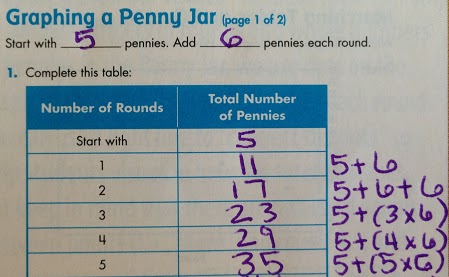
Our Math Workshop emphasis in recent weeks has been centered around analyzing relationships between two quantities in situations of constant change. These situations have started out very concretely, through using actual pennies and linking cubes, and then representing these situations more abstractly with arithmetic expressions.
In the above "penny jar" situation, there is a starting number of 5 pennies in the "jar". Then, 6 pennies are added each "round". The total number of pennies shown is (5 x 6) + 5, or 35 pennies. Students have been challenged to extend patterns such as this one, in order to determine the total number of pennies for any round. If asked to identify the number of pennies in the 20th round, for example, students would determine that there are 20 groups of 6 pennies (20 x 6), and then 5 more (+5) when including the "starting" pennies in the jar: 20 x 6 + 5 = 125. There would be 125 pennies in the jar after 20 rounds of adding 6 pennies each round. The most general arithmetic expression to represent "any" round might be n x 6 + 5, or 6n + 5.
These Investigations (from our Scott Foresman curriculum tool) have provided tables, such as the example shown above, in helping students make sense of (and represent) these situations algebraically.
In the above "double tower" situation, there are two skylights. As new "floors" are added to the double tower, the number of skylights never changes. Students have learned to represent this as "+2". Each time a floor is added, however, the double tower gains 6 new windows. The example above has 2 floors. This would be represented as 6 + 6 + 2, or 2 x 6 + 2. There are a total of 14 windows on this tower. Again, students have learned through active exploration (by actually constructing various towers with linking cube manipulatives as they fill in provided charts) how to represent this situation with a general arithmetic expression: n x 6 + 2 (6n + 2). How many windows would be on the 100th floor of this tower? To solve, students would simply calculate 100 x 6 + 2. A 100 floor double tower would have 602 windows.
Upcoming investigations will include building, analyzing, and representing Corner Towers & Square Towers. Students will be challenged to represent these situations of constant change by creating an arithmetic expression using a variable so that the number of windows on ANY given floor can quickly be determined.
Happy Mathematizing,
In the above "penny jar" situation, there is a starting number of 5 pennies in the "jar". Then, 6 pennies are added each "round". The total number of pennies shown is (5 x 6) + 5, or 35 pennies. Students have been challenged to extend patterns such as this one, in order to determine the total number of pennies for any round. If asked to identify the number of pennies in the 20th round, for example, students would determine that there are 20 groups of 6 pennies (20 x 6), and then 5 more (+5) when including the "starting" pennies in the jar: 20 x 6 + 5 = 125. There would be 125 pennies in the jar after 20 rounds of adding 6 pennies each round. The most general arithmetic expression to represent "any" round might be n x 6 + 5, or 6n + 5.
In the above "double tower" situation, there are two skylights. As new "floors" are added to the double tower, the number of skylights never changes. Students have learned to represent this as "+2". Each time a floor is added, however, the double tower gains 6 new windows. The example above has 2 floors. This would be represented as 6 + 6 + 2, or 2 x 6 + 2. There are a total of 14 windows on this tower. Again, students have learned through active exploration (by actually constructing various towers with linking cube manipulatives as they fill in provided charts) how to represent this situation with a general arithmetic expression: n x 6 + 2 (6n + 2). How many windows would be on the 100th floor of this tower? To solve, students would simply calculate 100 x 6 + 2. A 100 floor double tower would have 602 windows.
Upcoming investigations will include building, analyzing, and representing Corner Towers & Square Towers. Students will be challenged to represent these situations of constant change by creating an arithmetic expression using a variable so that the number of windows on ANY given floor can quickly be determined.
Happy Mathematizing,
Saturday, January 25, 2014
Navigating Historical Fiction: Focusing on Setting First
Readers at Wild Adventures are quickly falling in love with a new genre -- historical fiction!
Often, when students come to fourth grade, they still think books are one of two "genres": fiction or nonfiction. This year, readers are learning that calling a book "fiction" or "nonfiction" is like saying a dog is an animal or an oak tree is a plant. There is so much more that we could say! We can consider "fiction" and "nonfiction" the "kingdoms" of the literary world, and now that we're older, we are getting to know the "species" within each.
Recently, we learned that we read historical fiction much the same way as we would read any other type of narrative text (mystery, realistic fiction, narrative nonfiction, etc.). We focus deeply on the characters. However, as we read stories that take place in times (and sometimes places) far away from the world we live in, we also need to pay careful attention to the setting. Where in the world is this taking place? When in history is this story set? Once we've established the where and when in a global sense, we move towards understanding the traits of the setting, just as we would understand the traits of a character.
In our newest read aloud, Esperanza Rising by Pam Muñoz Ryan, the year (1930) and geographic location (Aguascalientes, Mexico) are clearly announced to the reader. As we read on, we learned Esperanza's family owns and lives on a vineyard and ranch, El Rancho de las Rosas. But in order to truly understand Esperanza's story, we have to understand what kind of place and time this really was for the people living within it.
This passage revealed to many readers in our room that Esperanza's home was a wealthy home. It was the kind of place that probably left Esperanza wanting nothing she didn't already have.
Later, as we read descriptions of the fiesta that occurred each year after the harvest, and Esperanza's thoughts about her future Quinceañeras, many readers said they could tell it was a traditional home, consistent and predictable from year to year. We know that carrying these understandings with us as we walk with the characters through their story is important because it helps us have empathy and a deeper understanding of the characters behaviors, actions, choices, and traits.
Readers, revisit this passage from the first chapter. Think carefully about the details Pam Muñoz Ryan included. What words would you use to describe the setting of our story after you've reread this passage closely?
I can't wait to see your thinking in the comments below!
Often, when students come to fourth grade, they still think books are one of two "genres": fiction or nonfiction. This year, readers are learning that calling a book "fiction" or "nonfiction" is like saying a dog is an animal or an oak tree is a plant. There is so much more that we could say! We can consider "fiction" and "nonfiction" the "kingdoms" of the literary world, and now that we're older, we are getting to know the "species" within each.
Recently, we learned that we read historical fiction much the same way as we would read any other type of narrative text (mystery, realistic fiction, narrative nonfiction, etc.). We focus deeply on the characters. However, as we read stories that take place in times (and sometimes places) far away from the world we live in, we also need to pay careful attention to the setting. Where in the world is this taking place? When in history is this story set? Once we've established the where and when in a global sense, we move towards understanding the traits of the setting, just as we would understand the traits of a character.
In our newest read aloud, Esperanza Rising by Pam Muñoz Ryan, the year (1930) and geographic location (Aguascalientes, Mexico) are clearly announced to the reader. As we read on, we learned Esperanza's family owns and lives on a vineyard and ranch, El Rancho de las Rosas. But in order to truly understand Esperanza's story, we have to understand what kind of place and time this really was for the people living within it. "Everyone who lived and worked on El Rancho de las Rosas was gathered at the edge of the field: Esperanza's family, the house servants in their long white aprons, the vaqueros already sitting on their horses ready to ride out to the cattle, and fifty or sixty campesinos, straw hats in their hands, holding their own knives ready."
This passage revealed to many readers in our room that Esperanza's home was a wealthy home. It was the kind of place that probably left Esperanza wanting nothing she didn't already have.
Later, as we read descriptions of the fiesta that occurred each year after the harvest, and Esperanza's thoughts about her future Quinceañeras, many readers said they could tell it was a traditional home, consistent and predictable from year to year. We know that carrying these understandings with us as we walk with the characters through their story is important because it helps us have empathy and a deeper understanding of the characters behaviors, actions, choices, and traits.
Readers, revisit this passage from the first chapter. Think carefully about the details Pam Muñoz Ryan included. What words would you use to describe the setting of our story after you've reread this passage closely?
"He swept his hand toward the grapevines, signaling Esperanza. When she walked toward the arbors and glanced back at her parents, they both smiled and nodded, encouraging her forward. When she reached the vines, she separated the leaves and carefully grasped a thick stem. She put the knife to it, and with a quick swipe, the heavy cluster of grapes dropped into her waiting hand. Esperanza walked back to Papa and handed him the fruit. Papa kissed it and held it up for all to see.
'¡La cosecha!' said Papa. "Harvest!"
'¡Ole! ¡Ole!' A cheer echoed around them.
The campesinos, the field-workers, spread out over the land and began the task of reaping the fields. Esperanza stood between Mama and Papa, with her arms linked to theirs, and admired the activity of the workers.
'Papi, this is my favorite time of year,' she said, watching the brightly colored shirts of the workers slowly moving among the arbors. Wagons rattled back and forth from the fields to the big barns where the grapes would be stored until they went to the winery."
I can't wait to see your thinking in the comments below!
Sunday, January 12, 2014
Multicultural Luncheon
Multicultural Luncheon on PhotoPeach
Plantain chips from Cuba, Empanadas from Mexico & Colombia, Tea & Cookies from England, Scones from Scotland, Petit Fours from France, Swedish Meatballs from Sweden, Eggrolls from Vietnam, Pasta from Italy, Baklava from Greece, Latkaes & Gelt from Israel, Rolled Cabbage from Romania, Enchiladas from Mexico, Apple Dessert from Germany, Brats & Sauerkraut from Germany, Dessert from India, Matzah Ball from Central Europe, Pastry Meringues from France.....We had a delightful time with our family members who were able to attend. What a great opportunity for fellowship and fun! Many students even tried "new" things that they had never tasted before. Thank you to everyone who was able to contribute toward our luncheon's success.
St. Augustine
St. Augustine 2014 on PhotoPeach
Our trip to St. Augustine was a memorable one. The weather was perfect and our tours were very informative. Here are a few FUN FACTS that we learned while there:
1) The Castillo cannons could shoot a cannon ball a distance of about 3 1/2 miles.
2) The Catholic Cross where Pedro Menendez first arrived in St. Augustine is 208 feet tall. If it were any taller, it would need a red light to be visible to airplanes!
3) The oldest resident of St. Augustine is "Old Senator"- very large oak tree.
4) The Lightner Museum used to be one of Henry Flagler's hotels- there used to be a large indoor pool in there that measured 150 feet by 60 feet. (What was the area of this pool?)
5) St. Augustine marks the beginning of the Trail of Tears (which we will learn more about later this year).
Our trip to St. Augustine was a memorable one. The weather was perfect and our tours were very informative. Here are a few FUN FACTS that we learned while there:
1) The Castillo cannons could shoot a cannon ball a distance of about 3 1/2 miles.
2) The Catholic Cross where Pedro Menendez first arrived in St. Augustine is 208 feet tall. If it were any taller, it would need a red light to be visible to airplanes!
3) The oldest resident of St. Augustine is "Old Senator"- very large oak tree.
4) The Lightner Museum used to be one of Henry Flagler's hotels- there used to be a large indoor pool in there that measured 150 feet by 60 feet. (What was the area of this pool?)
5) St. Augustine marks the beginning of the Trail of Tears (which we will learn more about later this year).
Students, what other FUN FACTS can you remember? Leave a comment to tell us something interesting that you learned and you will earn $5 behavior bucks!
Saturday, January 4, 2014
Decisive Decimals
Upon returning from our holiday break our main mathematics focus will be to take our understanding of decimals to new levels by exploring them precisely on models such as grids and number lines. We will also review strategies for comparing and ordering decimals, which we explored back in December.
Here are three helpful strategies we have already learned:
Convert decimals to fractions with like denominators.
Convert decimals to their percent equivalents.
Happy Mathematizing,
Thursday, December 5, 2013
Fun with Fractions
In Math Workshop, we have been been studying area models of fractions. Through homework, we have also been reviewing fraction concept using linear models (number lines) and set models (groups of objects). All of these models are important in helping to develop conceptual understanding of fractions.
The links below are helpful in reviewing some of the "big ideas" we have been studying in class. Use them to review and clarify your understanding of fractions. :-)
What are fractions?
Fractions
How can you make and identify equivalent fractions?
Equivalent Fractions
How do you find the "Greatest Common Factor" to put a fraction in lowest terms?
Greatest Common Factor
:-) Enjoy.
Students, leave a comment to share your thoughts on these Study Jams links.
The links below are helpful in reviewing some of the "big ideas" we have been studying in class. Use them to review and clarify your understanding of fractions. :-)
What are fractions?
Fractions
How can you make and identify equivalent fractions?
Equivalent Fractions
How do you find the "Greatest Common Factor" to put a fraction in lowest terms?
Greatest Common Factor
:-) Enjoy.
Students, leave a comment to share your thoughts on these Study Jams links.
Tuesday, November 26, 2013
Reading True Stories
Just when you thought you had nonfiction reading all figured out, in walks the black sheep of the nonfiction family -- NARRATIVE nonfiction!
Savvy readers know that narrative nonfiction is just a nonfiction text (a text designed to teach its reader) in disguise as an entertaining story. But those same savvy readers know that a story is a story is a story, no matter whether it's true or false. And how do we think about the stories we read? We think about the characters! This means we temporarily set aside all that we've learned about reading nonfiction -- boxing in main ideas of sections, listing (with bullets) the details that support those ideas, turning headings into questions, and using text features to deepen our learning -- and return to our sticky note type thoughts.
Readers should ask themselves:
After we finish the text, we can use the "Somebody-Wanted-But-So-Then" one-sentence summary frame to help us focus on what this true story taught.

When we read Bamboo Valley: A Story of Chinese Bamboo Forest, we realized quickly that we needed to expand our definition of a main character to include animals, or perhaps even plants. In this story, readers found the main character, a young panda, used his persistent, peaceful nature to overcome many obstacles to surviving alone in the forests of China. They summarized this book like this:
But just thinking about what you read isn't always enough. Just as we would ask ourselves, "Why is this important?" after we finish an informational text, we must think deeply to find the unifying ideas within a narrative nonfiction. One strategy for digging deeper into a true story is to think about the character's choices, challenges and lessons.
Today, our readers recognized that, on a December 1st, very long ago, Mrs. Parks made a pivotal choice, or a choice that changed the course of her story, when she said "no" to not only the bus driver, but also the police officer, when she was asked to give up her seat. Readers quickly saw that the immediate consequence of her arrest was only one of many effects of this choice. (We learned that the word "consequence" doesn't always mean "punishment"!) As a result of her personal choice, the women of her community organized a bus boycott, Dr. Martin Luther King, Jr. brought national attention to her situation, and people all over the nation sent their support to those boycotting the buses. Ultimately, her simple choice to say "no" led to change on a national level. To us, this meant we could make a small choice -- whether it's picking up trash on the beach or playground, or inviting someone to join us at the lunch table or on the recess field -- and know that our small choice could somehow lead to a big change, bigger than we might ever imagined possible!
Readers, we thought about so much more today. What were some of your "take away" thoughts after reading Rosa, by Nikki Giovanni? What do you recall about her challenges? What helped her through these challenges? How could we carry a little piece of this story and what it's taught us into our lives today? Take a moment to share with the world and our Chets Creek community what lessons we could take from this remarkable story.
Savvy readers know that narrative nonfiction is just a nonfiction text (a text designed to teach its reader) in disguise as an entertaining story. But those same savvy readers know that a story is a story is a story, no matter whether it's true or false. And how do we think about the stories we read? We think about the characters! This means we temporarily set aside all that we've learned about reading nonfiction -- boxing in main ideas of sections, listing (with bullets) the details that support those ideas, turning headings into questions, and using text features to deepen our learning -- and return to our sticky note type thoughts.
Readers should ask themselves:
- What kind of person is this character? What are their traits?
- What does this character want or need?
- What are their obstacles, dangers or struggles?
After we finish the text, we can use the "Somebody-Wanted-But-So-Then" one-sentence summary frame to help us focus on what this true story taught.

When we read Bamboo Valley: A Story of Chinese Bamboo Forest, we realized quickly that we needed to expand our definition of a main character to include animals, or perhaps even plants. In this story, readers found the main character, a young panda, used his persistent, peaceful nature to overcome many obstacles to surviving alone in the forests of China. They summarized this book like this:
The panda wanted to find a new home with water, live bamboo, and shelter, but everywhere he looked there was already another animal living there or no food, so he kept looking and walking for many miles, then he finally found a new valley with live bamboo & water.
But just thinking about what you read isn't always enough. Just as we would ask ourselves, "Why is this important?" after we finish an informational text, we must think deeply to find the unifying ideas within a narrative nonfiction. One strategy for digging deeper into a true story is to think about the character's choices, challenges and lessons.
Today, our readers recognized that, on a December 1st, very long ago, Mrs. Parks made a pivotal choice, or a choice that changed the course of her story, when she said "no" to not only the bus driver, but also the police officer, when she was asked to give up her seat. Readers quickly saw that the immediate consequence of her arrest was only one of many effects of this choice. (We learned that the word "consequence" doesn't always mean "punishment"!) As a result of her personal choice, the women of her community organized a bus boycott, Dr. Martin Luther King, Jr. brought national attention to her situation, and people all over the nation sent their support to those boycotting the buses. Ultimately, her simple choice to say "no" led to change on a national level. To us, this meant we could make a small choice -- whether it's picking up trash on the beach or playground, or inviting someone to join us at the lunch table or on the recess field -- and know that our small choice could somehow lead to a big change, bigger than we might ever imagined possible!
Readers, we thought about so much more today. What were some of your "take away" thoughts after reading Rosa, by Nikki Giovanni? What do you recall about her challenges? What helped her through these challenges? How could we carry a little piece of this story and what it's taught us into our lives today? Take a moment to share with the world and our Chets Creek community what lessons we could take from this remarkable story.
Monday, November 18, 2013
Nonfiction Reading
Even little baby readers know that reading nonfiction is different than reading fiction. I'll never forget the day that my own daughter came home with her first nonfiction book in a bag and announced, "Mommy, I can start anywhere I want to when I read tonight, because this book is NONFICTION!"
Now that we are more sophisticated readers, we know that this is only partly true. Good nonfiction readers do begin their nonfiction reading differently than their fiction reading, but it's not really about just picking a starting point. Reading nonfiction means thinking about the text before, during, and after our reading.
Taking it a step further, we've learned that sometimes readers can rephrase subheadings into questions, giving us a guiding purpose for our reading as we move throughout the article or book. As we read, we'll carry these questions in our mind, looking for the answers.
Now that we are more sophisticated readers, we know that this is only partly true. Good nonfiction readers do begin their nonfiction reading differently than their fiction reading, but it's not really about just picking a starting point. Reading nonfiction means thinking about the text before, during, and after our reading.
PREview, PREdict, PREpare
We've learned that nonfiction readers spend time before they ever begin reading the main text previewing the text. They focus on the text feature, which includes photographs, captions, diagrams, charts, maps, headings, footnotes, text boxes, and more. We use these text features to get an idea about the topic of the text and predict what main ideas we'll learn about.Taking it a step further, we've learned that sometimes readers can rephrase subheadings into questions, giving us a guiding purpose for our reading as we move throughout the article or book. As we read, we'll carry these questions in our mind, looking for the answers.
Stop and Think
Reading nonfiction means stopping and thinking many times throughout the text. As we come to the end of a section, we should stop to ask ourselves, "What did I just learn?" We can take this time to jot a quick main idea in the margins or box the main idea phrase in the text. The best readers might also underline the key words in supporting details, helping them hang onto their learning as they read.
Good readers will also ask, "How did this section fit with other sections I've read?" This second step helps us to recognize how the author has organized the text. Is the author writing to describe? Are they comparing and contrasting more than one idea or topic? Am I reading about a cause and its effect? Is that cause a problem? If so, did they also write about the solution? Does this text teach about a series of events that happen(ed) in a particular order, or sequence? Understanding how a text is structured gives us a glimpse into the author's purpose and helps a reader to understand the most important ideas of the text.
Think Back, Write Long & Talk
Good nonfiction readers do not just read texts and walk away. The best readers know that they're really reading nonfiction to become experts. The goal is to truly learn from our nonfiction reading. Learning means the knowledge you gain from a text becomes YOURS forever and always. In order to achieve this level or understanding and forever knowing, good readers will think back on all that they've read, asking questions like: What is the author's big idea? What do I think the author really wanted to teach me? What does that mean? Why is this important?
Two strategies for helping readers reach these deeper understandings are writing and talking. By putting what we've learned into our own words, orally or on a page, we're truly making it our own.
Readers, what are some strategies you've enjoyed learning and practicing for nonfiction reading? What is something you've learned about how reading nonfiction is different than reading fiction? How can these nonfiction reading strategies help you in your fiction reading?
Tuesday, November 5, 2013
Multiplication Strategies are Evolving!
Our work with multi-digit multiplication has certainly made progress since school started in August. Here is a review of the development of this learning trajectory:
Aah......our final destination. Once students feel they are ready to exercise this strategy, they must be able to explain it to me!
Can you see how all of these strategies are related? :-)
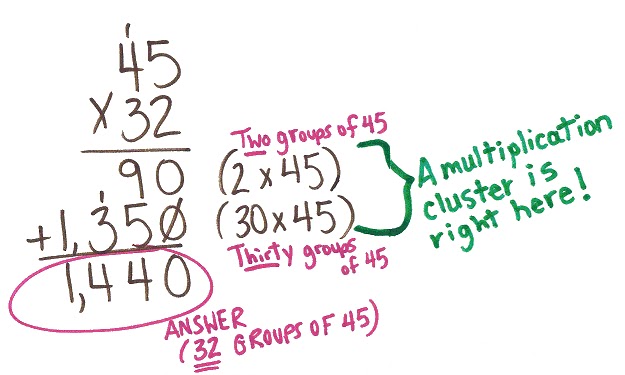
Multiplication Cluster
This strategy of decomposing one of the factors has empowered students to learn how to solve problems using mental mathematics. It has reinforced the concept of multiplication in that one factor represents the size of groups while the other factor represents the number of groups.
Open Array Model
This model has been fantastic as we have made sense of multiplication with larger factors because it has helped us not lose sight of the value of each factor and it has enabled us to decompose BOTH factors and keep track of finding all of the needed partial products.
Transition to the Traditional Algorithm
Recent efforts in math have been to use this model (which also decomposes both factors like the open array does) to understand how and why the traditional algorithm works. With this model, we practice multiplying in the same order that is used with the algorithm, but without the succinct regrouping. *Notice that the SAME four smaller problems solved here match the four smaller problems in the open array model above. These SAME four smaller problems are also calculated in our heads when using the traditional algorithm (below) too!
This transition strategy is a current focus during small group center time (when they work directly with me using the white boards). The students are catching on VERY quickly! It's quite impressive!!
--------------------------------------------------------------------------------
Later in the school year, we will connect all of the above pieces to this famous and widely-used strategy:
Traditional Algorithm
Aah......our final destination. Once students feel they are ready to exercise this strategy, they must be able to explain it to me!
--------------------------------------------------------------------------------
Can you see how all of these strategies are related? :-)
Subscribe to:
Posts (Atom)